


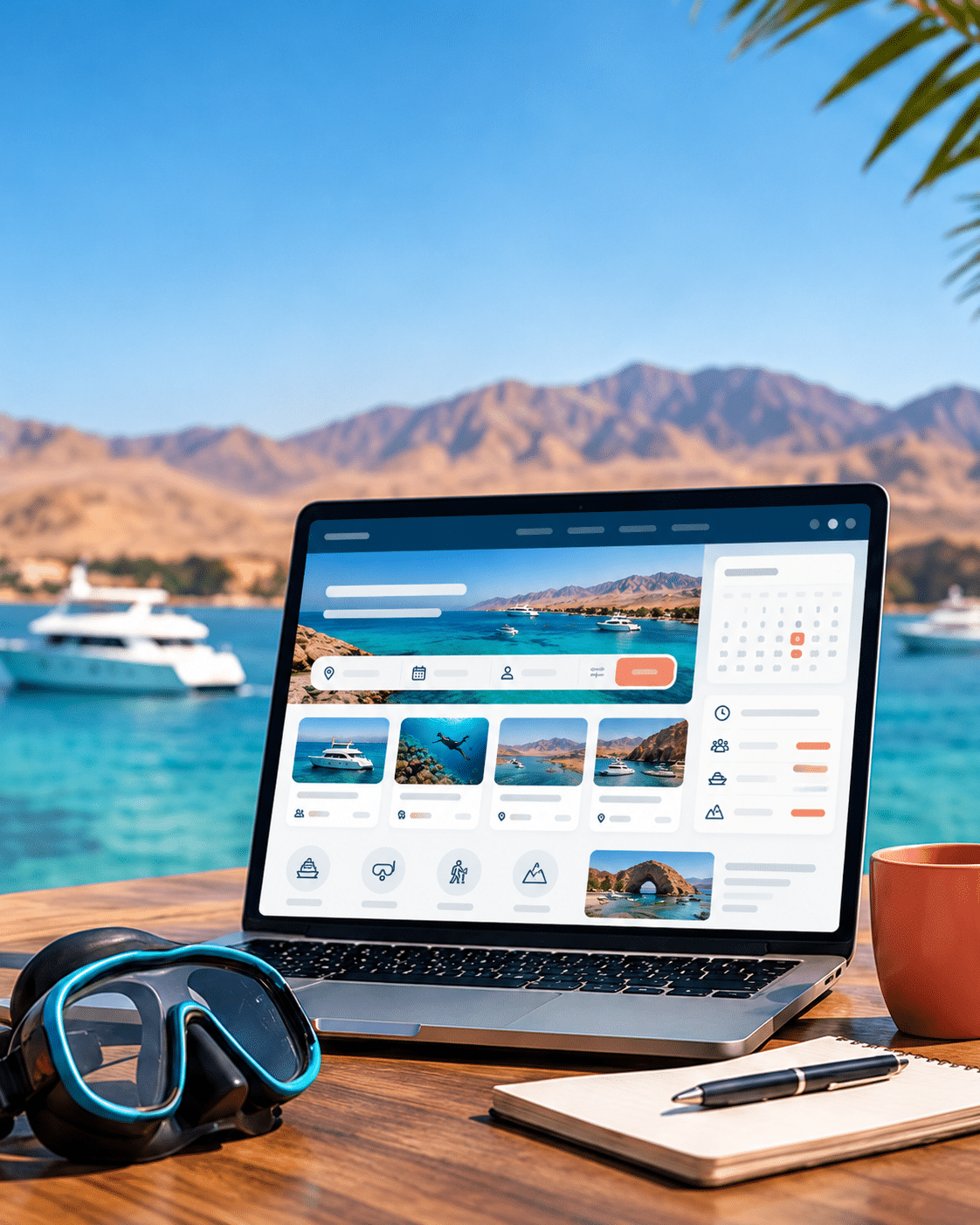
Tour Booking Software vs a Booking Website: What Do Operators Need?
Commercial tour operators, dive centers, safari and boat owners businesses in Sharm El Sheikh often struggle with digital distribution: should you invest in specialized tour booking software or build a dedicated booking website? When 20% to 30% of your gross turnover is surrendered to Online Travel Agencies (OTAs) like Viator and GetYourGuide, choosing the wrong digital setup drains operational margins and complicates inventory control.
Understanding the practical distinction between back-end operational software and customer-facing booking engines is the first step toward reclaiming direct margins and securing your customer data.
The Core Dilemma: Internal Logistics vs. Guest Acquisition
Many tour managers confuse administrative reservation platforms with transactional web experiences. A standard website acts as a digital storefront, whereas booking software serves as the administrative brain managing asset schedules, staff rosters, and equipment assignments.
Relying exclusively on one without the other leads to distinct points of friction:
- The Software Trap: Deploying back-office reservation software without an optimized direct booking web interface leaves you dependent on third-party aggregators for traffic, sustaining the 30% commission tax.
- The Static Brochure Trap: Operating a visually appealing website that lacks direct transaction handling and real-time inventory checks forces tourists to submit open-ended inquiry forms, losing high-intent bookings directly to responsive competitors.
What Is Tour Booking Software? (The Operational Engine)
Tour booking software (often delivered as SaaS or centralized back-office systems) is designed primarily to manage inventory, internal capacities, and multi-channel distribution.
- Asset & Capacity Management: Caps daily boat seats for daily diving charters to Ras Mohamed National Park or limits quad bike fleet availability in Sinai safari centers.
- Manifests & Staff Scheduling: Generates daily passenger manifests, tracks dive guide allocations, and schedules dive instructor ratios in compliance with PADI/SSI standards.
- Channel Distribution (Channel Manager): Synchronizes seat inventory across external OTAs to prevent overbooking across multiple reseller channels.
Limitation: Most standalone booking software options charge recurring per-user fees or cut an extra 1.5% to 6% transaction fee per direct booking, while offering rigid, standardized checkout templates that fail to build strong brand trust among inbound European travelers.
What Is a Direct Booking Website? (The Revenue Front-End)
A direct booking website is a dedicated, brand-owned digital asset engineered specifically to drive visitors from initial discovery straight through to paid checkout.
- Custom Brand Identity & Storytelling: Tailored European-standard visual design that highlights safety protocols, vessel comfort, and activity itineraries.
- Local Search Dominance (SEO): High-converting landing pages structured to capture in-destination commercial searches (e.g., tourists searching from Naama Bay hotel rooms or marina boardwalks).
- Direct Multi-Currency Payments: Frictionless checkouts accepting EUR, GBP, USD, and EGP via localized gateways (such as Paymob or Fawry) [
Limitation: A custom website without real-time booking integration or operational inventory management requires manual intervention to confirm availability, creating inquiry drop-offs during overnight hours.
The Comparison: Software vs. Website Breakdown
| Operational Parameter | Tour Booking Software (Standalone SaaS) | Custom Direct Booking Website | Integrated Hybrid Setup (The Optimal Model) |
|---|---|---|---|
| Primary Objective | Internal capacity, scheduling, and distribution | Brand credibility, local SEO, and buyer conversion | End-to-end booking capture and real-time inventory fulfillment |
| Commission & Costs | Monthly subscription fees + booking transaction surcharges | One-off development investment + routine hosting/maintenance | Zero intermediary booking fees; standard payment gateway fees (~2.5–3%) only |
| Guest Data Ownership | Often shared or hosted within proprietary vendor databases | 100% owned by the business operator | 100% owned; fully connected to direct marketing and WhatsApp workflows |
| Traffic Acquisition | Minimal to none; requires pre-existing customer flow | Captures commercial search intent and organic Google traffic | High organic discovery funnel connected straight to automated checkout |
| Time-Zone Coverage | Automated calendar bookings | Contact forms often require manual follow-ups | 24/7 automated instant checkout and conversational WhatsApp triage |
The Red Sea Reality: Why Operators Lose Bookings Without Both
Operating in South Sinai presents distinct commercial dynamics:
- The In-Destination Window: Inbound travelers regularly book day excursions, check dives, or desert safaris after physically arriving at their hotels. If your website does not render instantly on mobile networks, search visibility is wasted.
- The Inquiry Leakage Penalty: Inbound European tourists represent roughly 70% of the Sharm El Sheikh market. When inquiries arrive after local operational hours, manual email responses result in up to a 22% conversion drop-off, pushing guests directly toward Viator or GetYourGuide.
- The Financial loss: On a standard $100 excursion, OTAs extract $25 to $30. Operating through your own high-performing booking system allows your business to retain approximately $97 in pure net profit per transaction.
The Integrated Architecture: How CompuSharm Bridges the Gap
Rather than forcing operators to choose between expensive operational platforms and static promotional websites, CompuSharm Media implements a unified direct conversion engine:
- Custom WordPress Infrastructure: High-speed, mobile-first architectures utilizing WordPress engines (such as Tourfic or WP Travel Engine) to manage live calendar departures, capacity caps, and adult/child pricing without recurring software licensing taxes.
- Direct Multi-Currency Payment Processing: Native integration with verified regional gateways (including Paymob, Fawry, and major international card schemes) to collect instant deposits in EUR, USD, GBP, and EGP [
- 24/7 WhatsApp Conversational Workflows: Automated official WhatsApp Business API routing to clarify departure points, verify medical waivers, and deliver payment links while your physical booking desk is closed.
Frequently Asked Commercial Questions
Do we need a monthly SaaS software subscription if we build a WordPress booking engine?
Not necessarily. For most independent day-trip operators, safari centers, and dive bases, an engineered WordPress direct booking integration (using tools like Tourfic or WP Travel Engine) provides full calendar availability, booking deposit handling, and passenger caps without costly per-booking SaaS subscription cuts.
Will direct booking technology interfere with our ongoing OTA distribution?
No. Direct booking systems operate concurrently with your OTA accounts. The goal is to capture high-margin direct traffic from search engines, returning guests, and word-of-mouth referrals, saving 20% to 30% on bookings you generate directly.