
Multilingual Tourism Websites: How to Choose Languages and Structure SEO
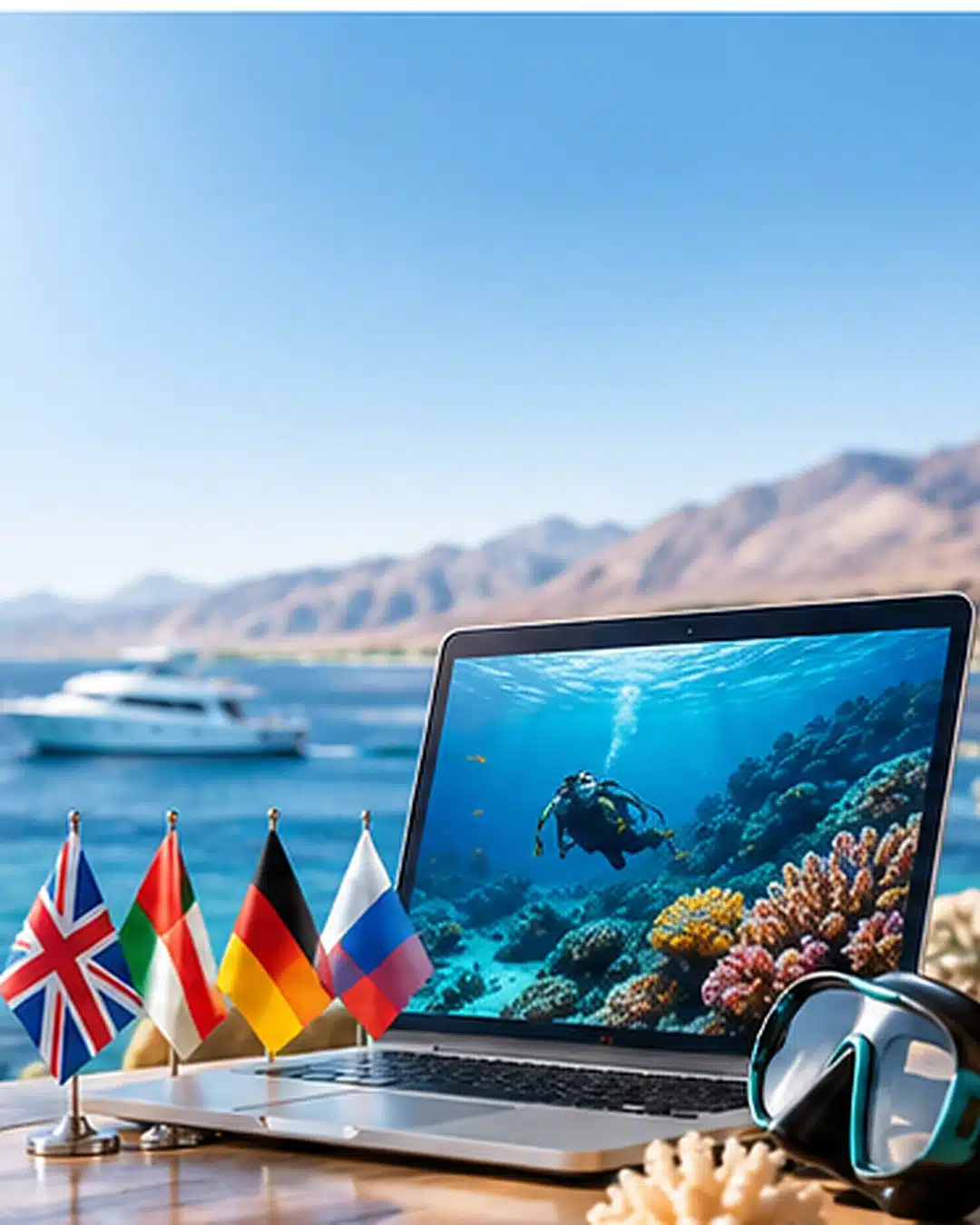
Operating an excursion company, desert safari, or dive center in destinations like Sharm El Sheikh means dealing with an international market by default. However, many local businesses operate websites solely in English, immediately surrendering international search visibility to Online Travel Agencies (OTAs) such as Viator and GetYourGuide.
Building a dedicated multilingual tourism website is not merely about translating text; it is an organic search engine optimization strategy engineered to intercept foreign travelers in their native language, retain full direct margins, and eliminate the 20% to 30% commission slice retained by third-party aggregators.
The OTA Language Monopoly: Why Single-Language Sites Bleed Direct Bookings
Aggregators win because they cater to travelers in their mother tongue. When an Italian, German, or Russian tourist plans an excursion to Ras Mohamed or the Straits of Tiran, they rarely initiate high-intent discovery searches using industry-standard English keywords.
When your website operates exclusively in English, you introduce immediate points of failure:
- Commission Bleed: Inbound travelers default to booking via OTA platforms that support their localized currency and language. A standard $100 excursion booked through an aggregator surrenders $20 to $30 in distribution fees. Processing that traveler directly nets roughly $97 after transactional fees.
- High Bounce Rates: Inbound European guests landing on a page they cannot comfortably navigate will quickly return to Google search results, signaling poor relevance to search engine crawlers.
- Lost High-Intent Queries: Unlocalized domains fail to rank for lucrative long-tail search queries in regional languages, leaving front-page organic real estate completely open to aggregators.
Strategic Market Selection: Which Languages Does Your Red Sea Operation Actually Need?
A frequent error made by activity operators is attempting to translate web content into ten different languages at once. This dilutes domain crawl equity, strains customer support resources, and produces low-quality automated translations.
Your language architecture must directly reflect physical passenger arrivals and airport logistics. In South Sinai, international inbound travelers account for approximately 70% of inbound volume, driven primarily by core regional European feeder markets:
- English (Core Global Anchor): The foundational operating layer for international communication, UK travelers, and independent European visitors.
- Italian (High Historic Volume): Essential for marine activities, daily diving charters, and boat excursions due to consistent inbound volume across Sharm El Sheikh and Dahab.
- German (High-Yield Independent Travelers): High demand for certified PADI/SSI courses, specialized guided diving, and structured itineraries requiring clear terms and detailed safety specifications.
- Russian (Broad Excursion Demand): High conversion potential for desert quad safaris, private boat rentals, and family coastal recreation.
Note: Add a language only if your booking desk or automated communications can handle inquiries in that language.
Technical Multilingual Architecture: Subdirectories vs. Subdomains and hreflang Configuration
Search engines do not index translated content automatically; search bots require clean technical signposts to identify geographic and linguistic targeting.
Example Architecture:
https://compusharm.com/ (English Anchor)
https://compusharm.com/it/ (Italian Directory)
https://compusharm.com/de/ (German Directory)
https://compusharm.com/ar/ (Arabic Directory)
Subdirectories (/it/, /de/) vs. Separate Domains
For independent tour operators, consolidating authority onto a single root domain using subdirectories (e.g., [domain.com/de/](https://domain.com/de/)) is the recommended path.
- Subdirectories: Pass inbound backlinks and root domain authority across all linguistic versions, accelerating indexation for smaller operators.
- Separate ccTLDs (domain.de, domain.it): Require multiplying domain hosting overhead, technical audits, and link-building investments by four or five times—an unsustainable model for local day-trip operators.
Flawless hreflang Implementation to Avoid Duplicate Content Penalties
The hreflang tag tells Google which linguistic edition of a page to display depending on the searcher’s geographic and linguistic settings. Failing to configure reciprocal hreflang annotations leads to internal keyword cannibalization and algorithmic penalties for duplicate content.
Every localized itinerary page must feature bidirectional cross-referencing in the HTML header:
HTML
<link rel=“alternate” hreflang=“en” href=“https://example.com/ras-mohamed-boat-trip/” />
<link rel=“alternate” hreflang=“it” href=“https://example.com/it/escursione-barca-ras-mohamed/” />
<link rel=“alternate” hreflang=“de” href=“https://example.com/de/bootsausflug-ras-mohamed/” />
<link rel=“alternate” hreflang=“x-default” href=“https://example.com/ras-mohamed-boat-trip/” />
The x-default Fallback: Always set the x-default attribute to your primary English booking page to serve international searchers whose linguistic preference is not explicitly mapped.
The Localization Trap: Machine Translation vs. Operational Intent
Deploying automated machine translation plugins directly onto a tourism website frequently damages buyer trust. Algorithms often mistranslate technical diving nomenclature, maritime safety parameters, and regional excursion details.
- Safety and Regulations: Translating nautical permits, Ras Mohamed National Park entrance fees, or PADI medical disclaimers carelessly introduces severe operational liabilities.
- Commercial Search Intent: A literal translation of an English phrase rarely matches the specific keyword a German or Italian tourist types into Google when looking to book a boat charter.
- Checkout Friction: If tour package descriptions are localized, but checkout forms and currency payment screens revert to English or an unmapped currency, prospective buyers abandon the transaction.
Connecting your multilingual architecture to a native direct booking engine ensures that pricing tiers, availability calendars, and payment gateways operate seamlessly across currencies.
Multilingual Architecture Checklist for Tour and Dive Operators
- [ ] Market Alignment: Base your language rollout on actual arrivals data rather than theoretical global reach.
- [ ] Structural Uniformity: Deploy clean subdirectory URLs (/it/, /de/) rather than confusing URL query parameters (?lang=it).
- [ ] Reciprocal hreflang Tags: Verify that every translated page points back to all other versions, including the self-referential tag and x-default.
- [ ] Nomenclature Verification: Check dive course labels (e.g., Intro Dive, Nitrox certifications) against official local and international marine guidelines.
- [ ] Multi-Currency Alignment: Verify that payment processing accepts key outbound traveler currencies (EUR, GBP, USD) alongside localized text.
- [ ] Automated Support Triage: Integrate multilingual conversational routing via the WhatsApp Business API to prevent non-English leads from dropping off during overnight hours.